If you run sales for an architectural metals company, a glass systems manufacturer, a facade contractor, or any other building products business with a specifier influenced commercial model, you have almost certainly experienced this problem: you are using tools and frameworks that were designed for a fundamentally different kind of selling.
The CRM templates came from a SaaS company. The pipeline stage definitions were borrowed from a sales methodology designed for transactional B2B deals. The forecasting model weights probability by stage in a way that makes no sense when a deal in Bid stage might close in three weeks or stay open for eighteen months depending on a project schedule your team cannot control.
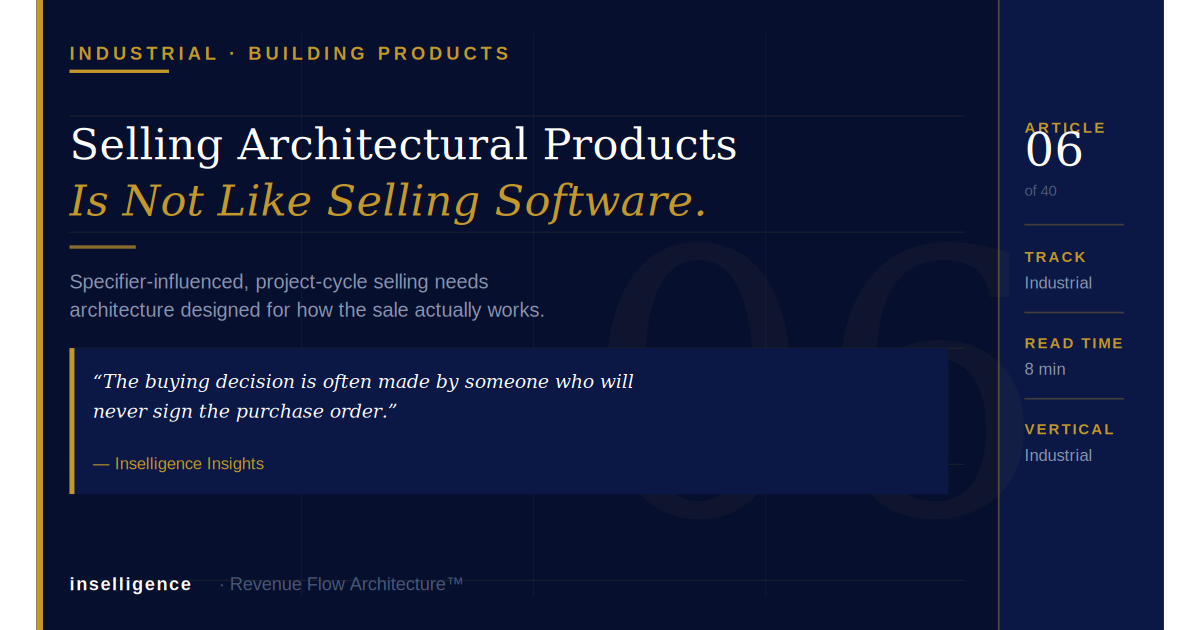
The buying decision for an architectural product is often made by someone who will never sign the purchase order. And the purchase order is often placed by someone who had no influence over the specification. That structure requires a commercial architecture that standard CRM templates cannot model.
The Specifier Problem
In the architectural products world, the specification is the commercial event that matters most. An architect or engineer specifying your product into a project is not a sales interaction in the conventional sense. It is a technical decision made during design development, often 12 to 24 months before the project breaks ground.
This creates a commercial motion that most CRM architectures cannot model. There are at least three distinct relationship types that matter in every significant project: the specifier who writes the spec, the GC or facade contractor who pulls the product, and the owner or developer who may have approval authority over product substitutions. These three parties have different information needs, different timelines, different leverage points, and different interactions with your commercial team.
A CRM configured with a standard opportunity based pipeline cannot represent this structure. The specifier influence, the pull through relationship with the contractor, and the owner approval dynamic are invisible in the data. Leadership is flying blind on the dimensions of the commercial system that actually determine outcomes.
The Long Cycle Problem
The average significant architectural product project has a pursuit cycle spanning anywhere from 12 months to several years. During that time, the project itself may be redesigned, rebid, delayed, value engineered, or cancelled.
A pipeline that represents these realities accurately looks nothing like a standard B2B software pipeline. The stages are something closer to: Design Development Influence, Specification Confirmed, Project Active, Bidding, Awarded, and Purchased. Each stage has different action requirements, different decision maker dynamics, and different probability drivers.
Probability weighting cannot be based on stage alone. It depends on whether the specification is strong or weak, whether the project is funded, how many projects the relevant GC has bid in your product category, and whether there are known competitive substitution risks.
The Geographic and Channel Complexity
Most building products companies sell through multiple channels simultaneously: direct to owners on significant projects, through facade contractors on medium projects, through distribution on smaller projects. Each channel has different economics, different relationship requirements, and different commercial dynamics.
A commercial architecture that consolidates all of these into one pipeline with one set of stages is systematically losing information that matters for decision making.
What the Architecture Needs to Solve
A commercial architecture designed for an architectural products business needs to do four things that standard templates do not do.
First: model the specifier relationship and the pull through relationship as distinct commercial assets, not as secondary contacts on a single opportunity record.
Second: stage definitions and probability models that account for project specific variables: funding status, specification strength, competitive risk, and contractor relationship depth.
Third: territory and channel segmentation that is native to the reporting structure, not applied as a filter on a flat pipeline.
Fourth: connection between specification influence activity and purchase order outcomes, allowing the organization to measure the return on its specification investment.
Start with the Revenue Flow Snapshot
We work specifically with industrial and building products companies. The Snapshot connects to your existing CRM and surfaces where your current architecture is losing visibility on the commercial dimensions that matter most in your selling environment. Practitioner led. 48 hours. No pitch.